

Warning: This article provides a practical summary of some of the most common situations covered by the Rules of Golf. It will help you navigate the course and better prepare for the handicap theory test, but it does not replace the official rules of the R&A, the USGA, or the Royal Spanish Golf Federation.
If you're looking for a clear guide to the rules of golf, here's a summary designed for players who want to hit the course without getting stuck on every question: lost ball, out of bounds, penalty areas, drops, green, pace of play, and official study resources.
At the end of the article you will find links to the official regulations, rules apps and useful resources to prepare for the handicap theory test.
The good news is that the current Rules of Golf are organized into 25 main rules. You don't need to memorize them all to start playing, but it's helpful to understand the situations that most often occur during a round.
The R&A and the USGA have simplified and modernized the rules to make them easier to consult. Even so, when there is a specific question in competition, it is always best to refer to the official text or consult the committee.
Before we get into the details, an important clarification: “dropping” means releasing the ball from knee height to put it back into play within a permitted area. It is used when you are entitled to relief or when you choose to accept a penalty to get out of a difficult situation.
In other words: if you can't play the ball as it is, the rules may give you an option to continue, but often that option involves a penalty stroke.
Contents of this guide
Golf rules: how they are structured
To make sense of the rules, it's helpful to first understand how they're organized. You don't need to memorize this section, but it will help you know where to look if you have a question.
- Rules: These are the 25 main rules. For example, Rule 1 deals with the game, player conduct, and the application of the rules.
- Subrules: They break down each rule into more specific situations. For example, Rule 14.3 explains how to drop a ball into a relief area.
- Clauses: These are more specific sections within a subrule, identified by letters. For example, 14.3a, 14.3bo, 14.3c.
- Definitions: They clarify key terms such as “penalty area”, “green”, “lost ball”, “relief” or “out of bounds”.
- Committee Procedures: They guide committees and referees on how to apply the rules in competitions.
- Model Local Rules: allow a field or tournament to adopt specific rules within the limits permitted by the regulations.
Golf rules summarized: what you'll use most on the course
- Lost ball: You have 3 minutes to find it.
- Out of limits: You must repeat from the previous stroke with penalty.
- Penalty area: You can play the ball as is or take relief with a penalty.
- Unplayable ball: You can declare it unplayable and choose a relief option with a penalty stroke.
- Correct drop: It is done from knee height and the ball should remain in the relief area.
1. Basic golf rules you should know
- Play the ball as it is. As a general rule, you cannot improve your position or the conditions that affect the shot. Rule 9.1.
- Don't intentionally improve the field. Avoid moving, bending, or breaking items to facilitate the blow. Rule 8.1a.
- Hit the ball, don't push it. The shot should be made with the head of the club, without pushing, scraping or scooping the ball. Rule 10.1a.
2. How to play a hole correctly
- Ball search: You have 3 minutes to find her. If she doesn't turn up within that time, she's considered lost. Rule 18.2a(1).
- Lost ball or out of bounds: You must repeat the stroke from the previous point and add a penalty stroke. Rule 18.2b.
- Unplayable ball: You can declare it unplayable and choose a relief option with a penalty stroke. Rule 19.2.
- Penalty area: You can play the ball as is or take relief with penalty, depending on the type of area and the situation. Rule 17.1d.
3. How to drop correctly in golf
- Drop height: The ball should be released from knee height. Rule 14.3b(2).
- Relief area: The ball must fall and come to rest within the permitted area. Rule 14.3c.
- If it rolls off: You usually have to repeat the drop. If it comes up again, it's placed according to the corresponding procedure. Rule 14.3c(2).
If you want to see concrete examples, here's a more detailed guide on How to know where to drop in golf.
4. Common penalties in golf
- Lost ball or out of bounds: a penalty stroke and replay from the place of the previous stroke. Rule 18.2b.
- Playing from the wrong place: This may result in the general penalty, which in stroke play is two strokes. Rule 14.7.
- Playing the wrong ball: In stroke play, there is a two-stroke penalty and you must correct the mistake. Rule 6.3c.
- Moving the ball accidentally on the green: There is no penalty, but you must put it back in its place. Rule 13.1d.
- Poorly executed drop: If you don't correct the procedure and play from an unauthorized location, you may end up playing from the wrong place. Rules 14.3 and 14.7.
5. Rules of golf on the green
- You can repair damage to the green. This includes ball punctures, nail marks, and other permitted damage. Rule 13.1.
- If you accidentally move the ball on the green, There is no penalty, but you must replace it. Rule 13.1d.
- If a moving ball hits another ball at rest, There is usually no penalty and the corresponding procedure is applied. Rule 11.1a.
- Important exception: In stroke play, if both balls were on the green before the stroke and one ball hits the other, the player who made the stroke receives the general penalty.
- If your ball hits the flag on a putt, There is no penalty when the flagpole has been left in the hole. Rule 13.2a(2).
6. Rhythm of play and etiquette
- Play without delay. The general recommendation is to execute each hit in no more than 40 seconds when it is your turn. Rule 5.6b.
- Maintain a good pace of play. If your group loses ground and another faster group is coming up behind, the sensible thing to do is to let them pass.
- Take care of the countryside. Repair pits, replace divots where appropriate, and rake the bunkers. Rule 1.2a.
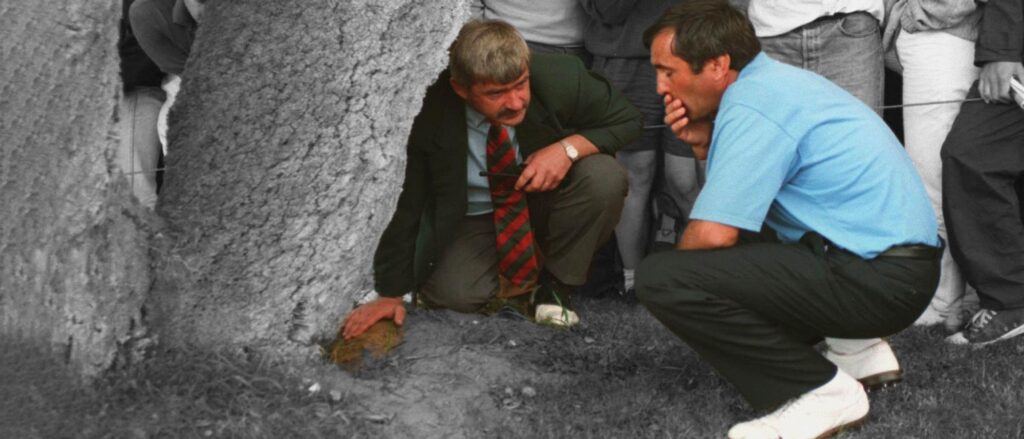
Golf rules for players and handicap test
If you're preparing for the theory test to obtain your handicap, don't just memorize answers. The most useful thing is to understand typical situations: what to do with a lost ball, when to drop, how to act in a penalty area, and what penalty applies in each case.
- The written test is usually based on the Rules for the Player, also known as the Player's Book.
- You can also check the rules from your mobile phone using the official R&A app.
And if you want to resolve a specific situation on the course, there's a much more direct option: an AI-powered web application specializing in R&A and USGA golf rules. You can upload a photo of the situation, explain what happened, and receive guidance on rules and strategy.
Is called LAZAR And it is designed precisely for those doubts that appear in the middle of a round: unplayable ball, relief, drop, penalty area, green, bunker or strange situations that you don't know how to classify.
As a visual complement, you can also watch the video. A Quick Guide to the Rules of Golf, produced by the R&A. It's in English, but you can turn on Spanish subtitles.
Finally, if you wish to consult the full text of the official regulations published by the Royal Spanish Golf Federation, you can access it here. Golf Rules Book in PDF.
Frequently Asked Questions about Golf Rules
How many rules of golf are there currently?
The current Rules of Golf are organized into 25 main rules. From there, each rule is further divided into sub-rules, sections, and definitions.
How much time do I have to find a lost ball?
You have 3 minutes to find it. If it is not found within that time, the ball is considered lost and you must proceed under stroke and distance.
From where is a ball dropped in golf?
The ball is dropped from knee height and must fall and come to rest within the corresponding relief area.
What happens if my ball goes out of bounds?
You must repeat the shot from the previous spot and add a penalty stroke. This is one of the most important things to understand before heading out onto the course.
Can I use AI to look up golf rules?
Yes, it can be a practical aid in guiding you through real-life situations, especially if you can provide a photo and explain the context. Even so, in competition, the official rules and the committee's decision always take precedence.




Thank you so much for the information and resources. They're very useful.
Thanks so much, Juan! You're helping me keep going.